

Earlier in the year, I sat down with a long-time fiduciary client to discuss splitting content marketing responsibilities with a new hire. The fact is that digital marketing has grown in complexity. We needed to review not only the shifting of roles, but what SEO, content marketing, and social media mean today.
New technologies, such as AI, and regular algorithm changes instigate doubt around current strategies. This is a common event whenever a new tool takes hold. But experienced content marketers deal in technique, not trends. Tools can enhance productivity but rarely dictate serious workflow changes.
Since AI hit the content market, I’ve had to guide clients across disciplines through questions such as:
- Do I still need a website (or do I need a website update)?
- Does social media still matter, and if so, what platforms work?
- What’s the difference between social, blogs, and the website?
- Can we just use an AI tool?
- How can we show up on ChatGPT (or Claude, or whatever LLM you prefer)
These are all reasonable questions as the economy constricts and prospects are more wary of where to put their money. At the same time, it can seem tempting to jump on every recommendation. But doing more marketing isn’t necessarily better. Like with researching assets and building a portfolio, successful content marketing in finance requires intention.
There is no one-size-fits-all marketing strategy for financial advisors. However, I aim to provide a starting point for a lean content strategy that takes disclosures and compliance into consideration.
Bare Minimum Content: The Fundamentals
Two truths about the current content landscape unlock current challenges: The market is saturated and your competitors are not what you think. Both are connected.
There are hundreds of millions of articles on broad financial topics indexed on Google. What is a 401k? Can I retire with $1 million? What is a wealth management firm? All of these are really consumer queries; they often also have high competition with little leeway to be unique. These topics have been done to death, not only by other advisors, but financial publishers.
Investopedia. Forbes. Nerdwallet. Kiplinger. These publishers take the top spots and have higher domain strength to maintain their position. More than other financial advisors in your area, these are the content creators you must compete against, and they have extensive educational libraries on any financial topic imaginable. Unseating articles from these publishers is not impossible, but it requires more strategic maneuvering. Basic definition articles will not cover it.
Social media is a bit more open, but far more crowded. Here, you likely are competing against local or national firms. But linking to your blog or posting educational graphics into the void offer minimal returns here, too. In fact, the rapid-paced nature of social media requires more input, more commenting, more interactions. This may not be feasible for advisors, although it is possible to easier identify and approach prospects directly.
I generally ask clients to look at these two components of marketing as fixed and variable assets.
Your blog articles, whitepapers, and guides are more similar to bonds or CDs. They offer lower returns but are stable. Their value grows overtime, so long as you maintain the principal and don’t give up at the first algorithm change. But changes are minimal, if built correctly, and these assets are largely passive after completion.
But not social media. Similar to trading equities, you need frequent touch points. Attention on each post can change based on user emotion, not only towards your post, but on the overall platform or news or anything else. Overall industry trends can dramatically affect what you’ll be commenting on—mergers, war, layoffs, new local investments…the market sentiment decides.
The Differentiated Advisor
Advisors must achieve three things with their content: It must be new, unique, and a value-add. Without the last piece, whatever content you invest in will have a low-impact. However, this can be challenging with compliance requirements.
Relevant and applicable content often offer the most value. But fiduciaries have a problem with many of the value-add methods businesses use.
You can’t recommend specific assets. Hypotheticals are often more problems than they’re worth. And even thought testimonials are now allowed, they also require more effort and disclosures to put into place.
The Differentiated Advisor, on a basic level across all content types, should leverage specificity, personal antecedent, and research to fulfill unique and high-value information. These must further be tailored to certain audiences.
Let’s consider an example. A fiduciary based in Nashville, TN that has many clients with an immigrant background might focus on:
- Tax and financial assets specific to client home-countries
- Balancing dual-nation assets to maximize retirement income
- When it’s a good idea to move to your home country in retirement (or stay in the USA)
- Nashville-specific financial considerations on investments and retirement, such rising housing costs, employment, and quality of life
Furthermore, this firm might include hyper-localized holidays on their social media roster, or cover community events. Finding threads to build trust with more prospects and clients adds stability to retention and increases awareness.
Download the worksheet below for a 15-minute strategy exercise:
Technical Requirements for Content Marketing for Financial Advisors
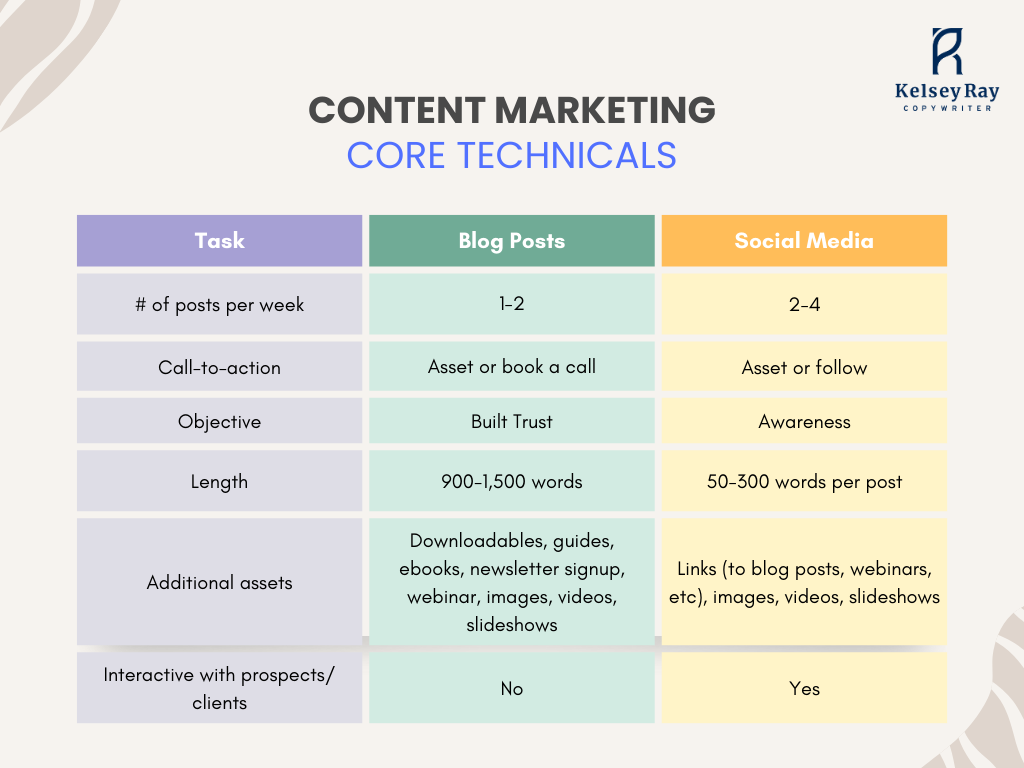
This is the “checklist” portion. The actions you can quantify are simple. Let’s look at blog posts first.
Generally, I have found over the years that there are certain points that improve your overall reach. There are small bumps after 30, 75, and 100 blog posts published, and I generally recommend most clients aim for at least 100 blogs for a solid and integrated content library. With 1 post a week, this takes 2-years to accomplish.
However, I have also seen success with mixing in specialized content with these blog posts. Webinars, videos, and downloadable ebooks or guides all add extra value long-term.
When it comes to social media, every professional will tell you something different. Generally, I would focus on 1 channel and maximize. If you love making short videos, use TikTok and post to a Facebook Page to keep it recent. Or, if you prefer writing, focus on LinkedIn.
Generally, I prefer LinkedIn for prospecting. You can easily identify individuals that meet your AUM criteria. Commenting on posts, providing direct messages with your downloadables, and posting 1-2x a week is the bare minimum. For example, you could connect with physicians and send them a retirement guide tailored with concerns specific to doctors.
You’ve likely seen the term “repurposing”, and you can double up content from your blog posts in newsletters with clients to boost retention or as your LinkedIn posts.
In short, I usually recommend fiduciary clients publish at least 2-4 blogs a month, maintain at least 6 long-form content pieces on their website, and optimize pages regularly. Furthermore, it’s important to not keep all marketing online, and having at least one in-person event per month can dovetail with your online presence.
Once you have a publishing rhythm and a growing content library, you can consider writing guest-posts or appearing on podcasts to test additional awareness campaigns. However, you need a strong “home base”. Without a fleshed out website and content library, people who find you from these appearances will have little to peruse.
Using AI: Misconceptions and Applications
There are two primary discussions regarding artificial intelligence (AI) in practice. I’ll begin with using it.
Artificial intelligence appears easier than writing content yourself or working with a content writer. However, AI is a predictive algorithm based on its database and your input — it can only give you what has already been written. This is the root of the inefficiencies that surround AI today.
It will not give you a working strategy, outline, or draft. Instead, it will tell you what has been written, what’s in the top articles, and, often, it’ll give you repetitive and bland outlines. I have had the unfortunate task of writing them out for clients who insisted it would be easier, without considering the adding investor expertise or specific insights to make the article unique.
There are writers who use AI in their research process. I am not one of them, simply because I find it faster and easier to do my own research and develop article concepts alongside my clients. This ensures every piece is relevant, unique, and compliant. And, of course, there’s an accountability question.
A machine cannot be accountable to mistakes. It does not think, it cannot argue its logic, and cannot be “punished.”
Depending heavily on artificial intelligence to plan and execute your digital marketing is high risk. I won’t tell you to use it or not, but to be intentional with how you want AI used in your brand.
The second discussion is how to appear in AI. The answer to this is simpler.
Follow sound SEO practices.
Large Language Models (LLM) catalog websites in a similar way as regular Google crawlers. My website, for example, shows up in ChatGPT without any added effort. A well-optimized site will show up in AI recommendations. Anyone telling you otherwise through new acronyms such as Artificial Intelligence Optimization (AIO) or Generative Engine Optimization (GEO) — it’s all rebranded SEO.
Reporting: Baseline Metrics for Content Success
Content marketing isn’t the same as sales. There is a tendency to conflate marketing ROI with sales metrics, namely converting leads into clients. This can happen. But that is not the purpose of content.
Namely, what we want from content is:
- Quality traffic: Higher numbers are ideal, but we also want people who stick around for longer than 15 seconds.
- Page funnel: What landing pages capture the most attention? Where do prospects go after? Can this tell us more about the buying content?
- Clicks and “conversion”: Are people downloading guides or booking calls? This is ideal, but not always traceable. Sometime might read your blog post in June, rediscover your site in August, and book a call in October.
On social media, you’ll also want to look at link clicks and comments over views. These indicators suggest a higher level of engagement and can turn into leads in the long-term.
Typically, you will start seeing results with content within the first year, often the first few months. Ideally, you’ll see upward trajectory within the first three months. Anything else requires a review of data and strategy.
Content Marketing for Financial Advisors Going Forward
One of the best pieces I have ever received is slow is smooth, smooth is fast. Apparently, it originates with the Navy SEALS. But it’s a slogan the most analytical minds I work with appreciate. When you are mired in research and analysis, you may move slowly in a layman’s perspective. But getting things right matters in financial advisory. And I’m not just talking about compliance here. Your client’s livelihood is at stake with every trade.
Content marketing has lower stakes. You’re unlikely to lose everything on one campaign. However, failing to experiment, pivot, and develop your differentiated approach in a way clients can understand hurts the bottom line. With economic volatility and rising inflation, clients need someone to explain the market. They will turn to you.
And, of course, if you would like help with that, I’m available to answer your questions or write your content.