

You’ve already seen it on LinkedIn: Post after post for or against AI. Most hyperbole. And, to be honest, I want to exit the conversation. The problem is that my writing colleagues aren’t the only ones debating the virtues and vices of this technology. My clients are, too.
I decided to conduct a final experiment to put any lingering questions or concerns I had to rest.
Before jumping into the experiment, I want to briefly cover my initial opinions going in and the methodology.
First, at the beginning of this experiment, I had pretty much abandoned all use of AI beyond an occasional transcription upload. Why? I’ve tried all the major AI-writing-related platforms over the past three years. ChatGPT, Claude, Jasper, MarketMuse, Clearscope, Frase, Surfer, Rytr, Article Forge, and Grammarly.
And all of them left me unimpressed. Combined with the ever-growing studies on AI’s affect on the environment and workers, including my hometown of Memphis, I decided just to just ignore the hype.
Until recently, I was still just as fast, anyway.
But it was clearly the tech had evolved. So, I designed this mini-experiment to get a real feel for the process AI-driven writers rave about.
Methodology
The methodology is simple. To keep things consistent, I:
- Selected a similar industry and sub-niche (sustainable marketing)
- Choose keywords with similar intent and search volume
- Directed my writing towards marketing managers and founders
- Maintained a similar word count
- Posted both articles on the same day
- Leveraged organic traffic from Facebook and LinkedIn on both articles
For the AI, I used Claude 4.6, as this is the most popular platform among professional writers. I recorded my time on each section, often doing the human portion of each subtask first before moving to the AI version. For example, I conducted keyword research first and used AI task second.
I only used the free version of Claude, which meant waiting 20 minutes between the outline and writing phase to replenish my tokens. Furthermore, I limited myself to 10 prompts, total.
The Essential Writing vs. AI Scorecard
Overall, AI was faster. It took me 3.31 hours to finish the piece by hand. Artificial intelligence took only 1.7 hours. That means I saved about 1.6 hours—not bad. But that’s only if you’re looking for speed.
In the below subsections, I’ll cover each step and it’s nuances for a more well-rounded view.
You can also read the full-articles on my website:
- Human-only: How to Market Sustainable Products
- Mostly AI: Storytelling that Doesn’t Scream Greenwashing
Keyword research
Time: 5 mins versus 4 mins
Keyword research isn’t as high on the agenda as it used to be. That said, selecting relevant keywords into a solid article can help with direction and build-in SEO potential. I only shaved a minute off my time here—hardly worth it. And I can’t vouch for the accuracy of the SEO data, since the platform lacks real-time data access.
That said, it was worth a shot.
Prompt: Please generate 20 SEO keywords with search volume greater than 30 and low competition on the topic of positioning or marketing your sustainable product or brand.
For the human-based research, I used Keywords Everywhere base data for search volume.
Claude provided me with 20 options per the prompt. While the accuracy of the data was in question, the presentation I liked. In fact, this was probably the best use of Claude in the entire process, although the Outline presentation was also more client-friendly.
Research
Time: 30 mins versus 10 mins
Research is a complex topic, because I often research before, during, and after the piece. As you write, new data points and questions can arise, meaning that research isn’t really finished until the article is published. But, for the sake of the study, I limited it to the pre-writing phase.
For me, research is the fun bit. But it can easily become cumbersome depending on your industry and data availability. For the topic of green or sustainable marketing, there are dozens of studies, reports, and examples to choose from.
When researching, I always look at both reports and questions I want to answer in my article. That’s why I also used two prompts in this section.
Prompt: Please list 15 objective scholarly articles or reports that provide hard data and insight into consumer behavior around purchasing sustainable or climate friendly products. Include links to the sources, statistics or quotes that would be relevant to an article on sustainable brand marketing, and ensure they cover sustainable food, sustainable climate tech, and sustainable fashion.
Prompt: List 15 questions an article on sustainability storytelling for brands should answer for marketing managers to better position their sustainability messaging and drive customer conversions.
Outline
Time: 8 mins versus 20 mins
Here is where we begin to see the human and machine processes diverge. Here, I was faster than the AI, with some caveats:
- Since this test was based on speed, I minimized details in my outline in favor of narrative structure.
- While Claude generated a highly-detailed outline, I did need to edit some sections in preparation for the writing section.
I had a few issues with the outline section. This is where we begin to see the limitations of AI. Yes, Claude and similar platforms train on vast datasets. But they can only pull from historical data—information that may be outdated, limited, or incorrect. The emphasis on the 3-beat structure and frankenstein “how to” sections, while decent enough for a blog post, didn’t scream original or high-value or new.
I really feel that from this point onward, any writer should be cautious of AI output and work to integrate new or unique information into the outline. This is also the first step to adjusting article structure—something I wish I would have spent more time on.
Prompt: Please generate an outline for a 1,500 word article using all the information in this chat. The article should be focused on helping marketing managers develop a unique sustainability storytelling strategy for their brand, regardless of industry. It educate on storytelling and narrative structure applied to branding, specific sustainability narratives, consumer expectations, best content types for sustainable storytelling, and narrative use across different distribution channels.
Writing
Time: 83 mins versus 5 mins
Since AI didn’t really write, I can say that it was a fun time writing the article. I wish I would have added more case studies, but that can always added as an ungated PDF or as another blog.
Generally, it took me an hour and 23 minutes to finish the rough draft—not bad.
Prompt: Please write an original article of 1500 words using the outline provided. Link to all sources used but do not pull wording directly from these sources but reinterpret them in your own words without sacrificing accuracy. The outline:
Editing
Time: 73 mins versus 65 mins
I want to stress that I focused, primarily on speed. Almost every AI-advocate focuses on how quick you can finish a draft. For that reason, I did not aim to spend more time on the AI article than necessary.
As a result, I didn’t spend as long editing the AI output as I wanted to. In part, because I didn’t enjoy it. The text, while passable, felt tedious and dense. Halfway through, I realized that each section was structured like an elaborate list, not a cohesive story.
That led me to a dilemma: Do I scratch out entire sections and rewrite them, or stick with the outline? And, in the end, since AI is supposed to save me time, I kept the integrity of the article.
But you’ll noticed I also spent longer editing my article. Part of that time was spent determining if I wanted to add more information, such as examples of sustainable products, as well as reviewing some studies. While it took longer, I enjoyed the process more. I felt I was working towards a genuinely helpful, higher-level article. The time mattered, just not as much as getting it right.
Preliminary analytics
A few weeks is not a lot of time to accumulate data. And I don’t expect my first two posts on sustainability in marketing to convert viewers (the overall infrastructure is still being build). But we’ll work with it.
So far, the human-written article outperforms the AI-written article. And this surprised me, because the post I wrote for the AI-article on LinkedIn got a lot more traction.
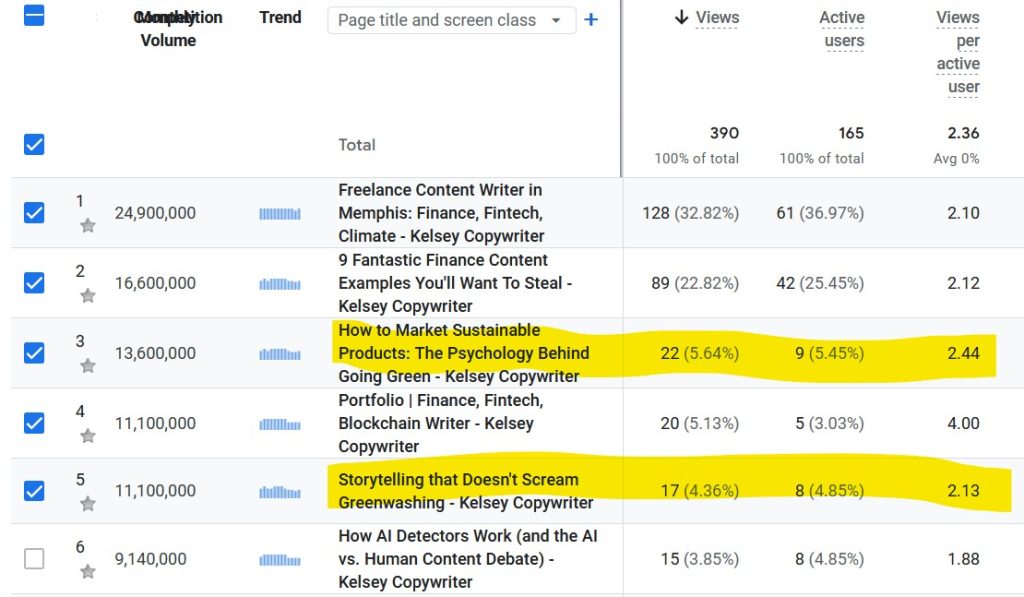
While the traffic differences are in the single-digits, I’ve noticed that the human-written article has gotten 50% more clicks than its competitor.
More than time: Calculating the cost
There’s a lot more to technology than time savings. First off, I didn’t enjoy the process. But enjoyment, too, is secondary to revenue and cost.
So, how much did I spend with AI?
Using the free plan for Claude, I had to wait 20 minutes to replenish my tokens. This is not reflected in the total time.
It also has an environmental cost. Using the Climate Aligned Calculator and adjusting for using AI 5 days a week, I found that this experiment would cost 1 extra bath a year. That doesn’t sound like a lot, at first. If you multiple that by hundreds of thousands of people, let alone companies and Agentic AI, that cost skyrockets.
Furthermore, I checked both articles against free AI detectors. While I view results with a grain of salt, my article ranked no higher than 4% AI written while the AI-article was always above 70%.
This was the first time I questioned the reality of AI’s environmental use, and whether it can be negotiated. While it seems reasonable, as an individual, it isn’t just me using AI. And when I look at xAI in Southaven, it’s clear that data centers aren’t all eager to be energy efficient or pro-community. Many are significant risks.
So, I’m still entirely onboard with integrating AI into my regular process. Sure, it saved me some time. That matters. But it has to align with my ethics, too.
Three things really have to change for this to happen:
- Transparent and standardized regulation for data centers that mandate clean energy and community protections.
- Data and copyright safeguards that ensure people are being compensated for contributing to training sets.
- Worker protections to avoid mass layoffs (even if AI is used as an excuse, not a primary factor) and employee harm.
Without these three policy changes, I cannot see myself purchasing or fully integrating AI into my workflow.
Because, yeah, I’d like to have an hour or two back per article. But I also want to enjoy my work, and ensure that my process as a minimal negative impact on others.
Work with me
As you can see, my feelings towards AI changed somewhat. Even if my process will stay the same for the foreseeable future, I love technology and I think it’s worth honestly experimenting with it.
And I love working with open-minded clients who balance innovation with risk, who see the value in narrative-driven marketing, and who want more than “good enough.”
If that sounds like you, book a no-commitment discovery call with me today.