

Joseph Campbell’s Hero’s Journey has provided marketers and founders with a simple, plug-and-play framework since it’s reception in 1949. But there’s a problem: It’s evolved into perfunctory equation. Award-winning author Adrian Tchaikovsky said it best in his interview with David Perell:
“Once you reduce something that far, then you’re left with a model that’s completely worthless. any framework is useful so long as it doesn’t become ‘this is the law’.”
Marketers and founders can not longer depend on this framework. Not only is it reductionist, but the internet is over-saturated with branded “heroes” and “journeys.” Sometimes we only get the “hero”—not even the full-scale transformation (product call-outs included).
What can marketers, copywriter, and other storytellers do to stand out?
Let’s talk about drafting a tangible, customer-oriented story with alternative narrative structures.
Pre-requisites: Time, Framing, Conflict, and Theme
Before we dig deep, it’s important to understand the following concepts, too. There are four key components that you need to weave into whatever structure you use:
- Time: There’s a few ways to talk about time. Linear, non-linear, parallel, episodic, circular. How do you maintain pacing and time? Linear is the easiest, most straightforward path. But playing with the flow of events can spice up your narrative.
- Framing/Perspective: Are we in the future looking back to the present? The present to the past? Whose point of view is the story?
- Conflict: Man versus…man? Nature? Machine? This goes beyond pain point. Tell me how that accounting issue scrapes at the bone of your reader. I’m talking hardcore anxiety-inducing, day-ruining irritation.
- Thematic Arcs: Identity, power, free will, survival, love, connection—what is the underlying thought explored through conflict and narrative? You may think that an AR plugin lacks a need for theme. You embed the code, your invoicing is automated, viola! But what if that empowers the accountant to address cash flow opportunities or identify fraud (increasing their reputation)?
Ditch the Three-acts. Use Beats.
Go into your AI or an elementary creative writing blog post and you’ll hear about the Three Act Structure. Sometimes it’s the Five-Act Structure. Regardless, it’s often just as unhelpful as the Hero’s Journey.
Instead, use a beat sheet.
The popular Save the Cat! framework popularized the beat sheet format, but there are several variations across genre.
The main thing to know about beats are this: Each beat is a moment that changes direction of the story. Each beat builds a scene. Instead of working with equations, you are working with building blocks. As a result, you can better refine and customize your story.
Let’s consider the following examples for the opening for blog posts across three radically different businesses:
| Brand | Loam Bio (agritech) | Thistle & Spire (fashion) | VNS Clinic (Healthcare) |
|---|---|---|---|
| keyword: regenerative agriculture carbon | keyword: comfortable flexible lingerie | keyword: adhd clinic Memphis, tn | |
| Opening Scene | A farmer in Australia faces degraded soil and lower yields | A recently divorced 40-something wants to feel beautiful again. | Single-mother of three realizes her child might have ADHD. |
| Beat 1 | He attends a regenerative farming seminar. | Old lingerie doesn’t fit. She gained weight in her marriage. It doesn’t match her style. It’s not comfortable. | Tom couldn’t sit still again in class. She’s been called to the office three times this week. He’s a good kid — but has high energy. |
| Beat 2 | Identifies areas for improvement but can’t afford them all —especially not at once. | Browsing aimlessly online, she decides to go into a boutique to try on different styles. | She’s on her phone. There’s a bazillion options for treatment. Does she go online? Maybe someone in person is better…how would she know the difference? |
| Beat 3 | Is there a way to improve seeds and soil health to improve yields and afford new adjustments? Yes. But there’s an application process. | Thistle & Spire catches her eye — the fabric is soft and stretchy but supportive. But it is worth the price tag? | She backtracks. Is it even ADHD? What kind of doctor should she see? What about insurance? She should do some research first. |
Each opening scene above includes three beats. All three are linear and from the perspective of the customer. But there are key differences:
- Conflict varies for each character.
- The farmer is working against nature, and many programs have an application process, causing friction that must be overcome.
- In contrast, the divorcee must overcome caution regarding price and value. It feels nice in the store, but is this really the confidence-building intimate wear for her?
- Finally, the mother is overwhelmed by information. She wants to do right by her son. She’s fighting against the complex system of healthcare without the privilege of certainty.
- The farmer is working against nature, and many programs have an application process, causing friction that must be overcome.
- As a consequence, action and motivation changes, too:
- The farmer will need to gather data for the program applications and map out the current farming strategy in the meantime.
- The divorcee compares clothing brands and feel. There might even be some flashbacks to brands she loved or hated—or moments in her difficult marriage that the right intimate wear made her feel stronger.
- The mother is on a fact-finding mission. The first trustworthy local psychiatrist to address her anxieties wins the appointment slot.
- The farmer will need to gather data for the program applications and map out the current farming strategy in the meantime.
Beats are ideal for personalizing otherwise generic keyword-driven content. But they also work well for organizing thought-leadership pieces and persona journeys. And if you’re married to the Three or Five Act structures…you can apply beats to them, too.
Alternative Frameworks
That said, the beat structure isn’t the only way to write a story. While there are dozens of options, I’m going to cover those most useful to marketers and content strategists here.
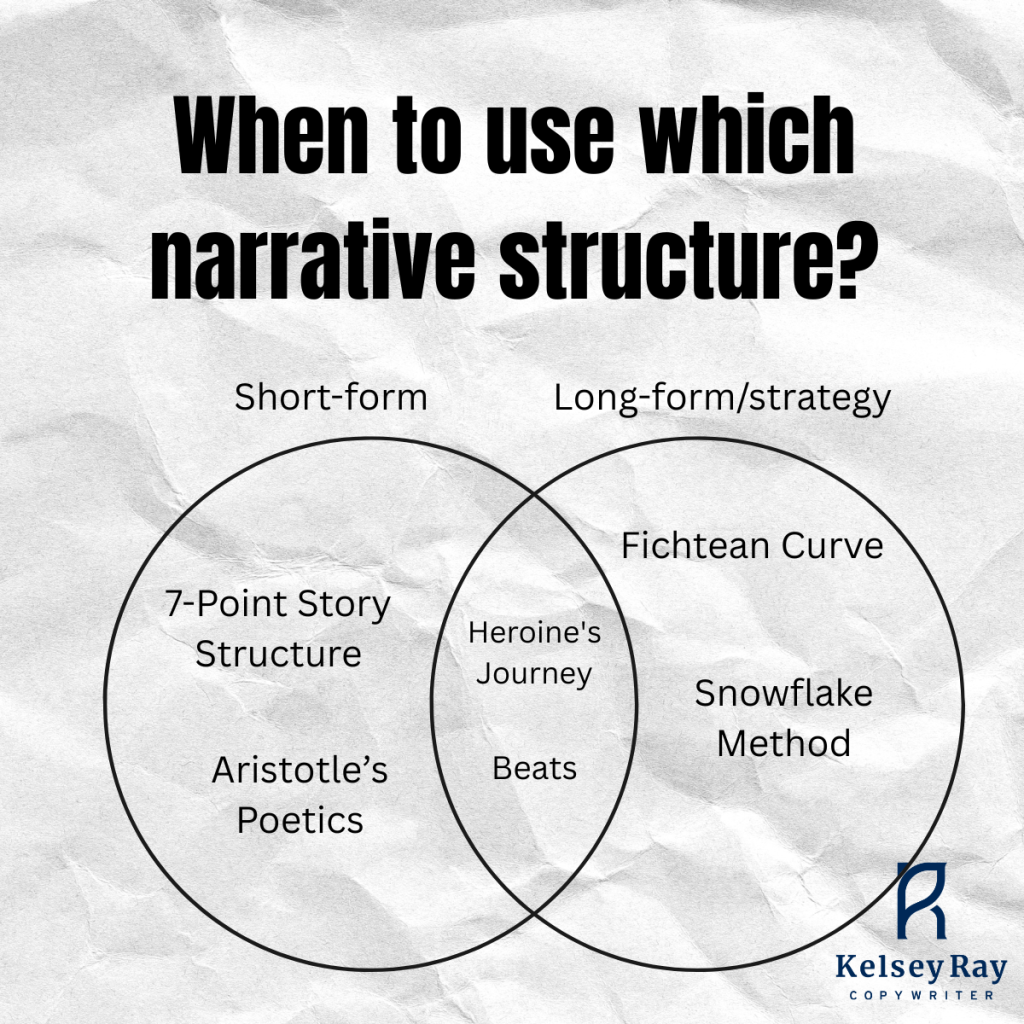
Streamlined beats: Aristotle’s Poetics
Aristotle narrowed down a successful story to a few components:
- The starting point
- The inciting incident or the catalyst — what sets the story off
- The main character’s primary objective
- Scene objectives
- The recognition or decision-making moment
- The reversal of the starting self, the consequences of the decision
John Gardner’s Fichtean Curve
This story structure emphasizes a series of conflicts, each more tense than the last. Taking the healthcare example of a mother looking for a local psychiatrist for her son, the Fichtean Curve might look like this:
- Her son gets in trouble in school — three times this week alone!
- She wonders if he has ADHD.
- She does research on what ADHD is.
- Okay, she looks at the symptoms, but which doctor is good? — she’ll ask a friend.
- She gets a referral but they don’t take her insurance and out-of-pocket is way too expensive.
- She finds another doctor but there aren’t any openings for three months!
- Okay, third time is the charm. She found a doctor for the initial assessment.
- They attend the appointment. Her son is difficult, but it’s confirmed he does have ADHD.
- The initial medications are expensive.
- They try a new brand — it works, but now it’s time to work on coping skills. How can she feel supported making all these changes?
This narrative spun out of the scope of a single blog post. But we can see how many hoops this woman has to jump through to get her son assessed and treated.
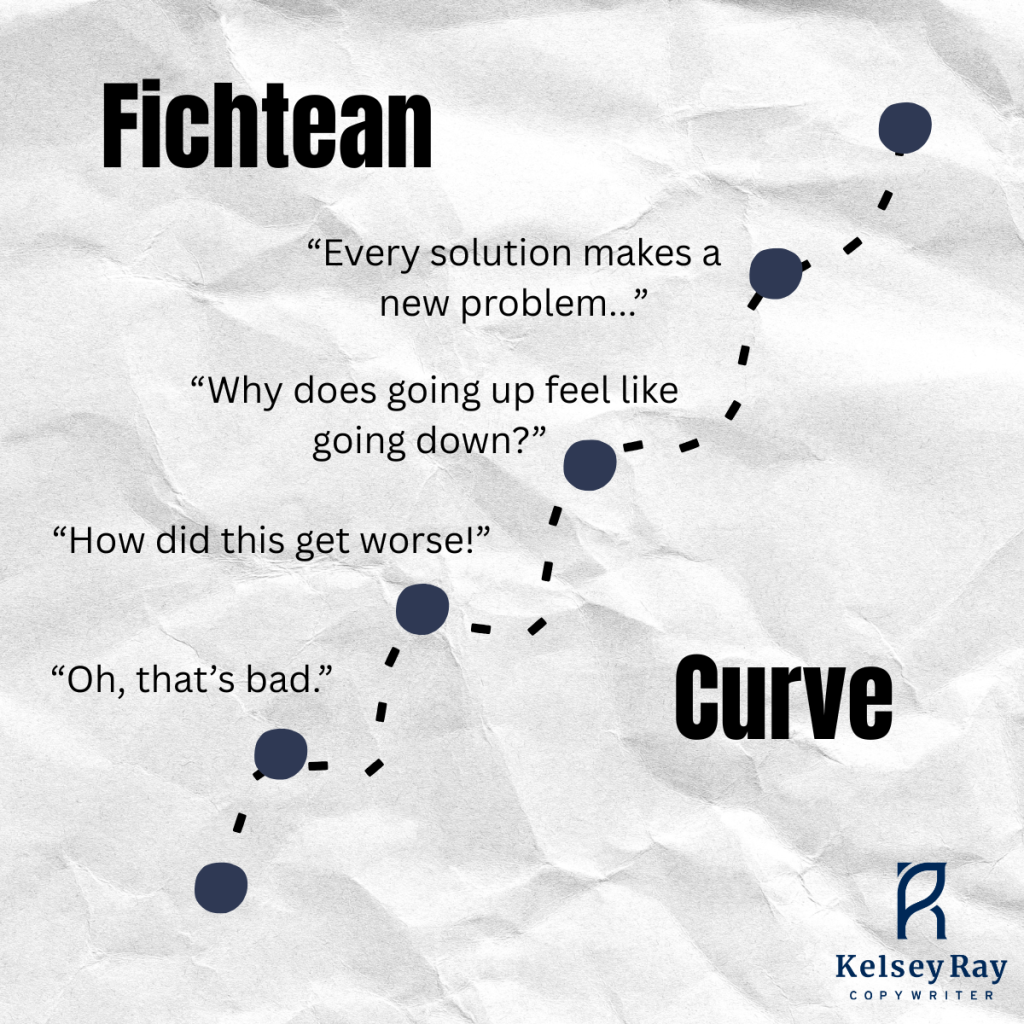
The Fichtean Curve is excellent for increasing the tension and for longer works, such as an interconnected content strategy, an eBook, or a longer whitepaper.
Heroine’s Journey
The Heroine’s Journey is a more elaborate and less reductionist version of the Hero’s Journey, developed by Maureen Murdock. While it was meant to demonstrate the female perspective, I think that it can easily be applied to both genders. Here is my modified take:
- Separation From the Feminine/Norm: The character abandons the status quo.
- Identify the Masculine and Gather Allies: This character uses traditional routes and actions to meet their objective.
- Road of Trials: They face challenges — sometimes multiple conflicts — to achieve their goal.
- Boon of Success: They see some success from their efforts. But it’s not enough.
- Realization of Spiritual Barrenness: Even though they have achieved some success, something feels like it’s missing. They have not truly met the objective.
- Initiation and Ascent to the Goddess: The heroine withdraws and reevaluates.
- Yearn to Connect to the Feminine/They Take a Risk On Themselves: They emerge from their darkness and try something new. They deviate from traditional routes.
- Healing of Mother/Daughter Split: They rediscover success in trusting themselves.
- Healing of Wounded Masculine: They keep the traditional actions that still offer value.
- Integration of Feminine and Masculine: The character reaches a new state of integration, but may transform again, in a different journey.
To conceptualize how this might look, let’s consider a packet for the farmer using regenerative farming:
- Separation From the Feminine/Norm: The farmer’s yield is shrinking. The soil is degrading. Things have to change.
- Identify the Masculine and Gather Allies: They attend a regenerative agriculture conference and several workshops.
- Road of Trials: Every change requires capital, relearning. They begin the process.
- Boon of Success: Regenerating the soil takes time. Initial plots are improving by half a percentage point.
- Realization of Spiritual Barrenness: It’s success but it’s not enough. Water shortages, extreme weather, and economic policies are changing faster than the soil is improving.
- Initiation and Ascent to the Goddess: The character goes back to the drawing board, dwelling on the financial feasibility of continuing.
- Yearn to Connect to the Feminine/They Take a Risk On Themselves: They emerge after researching and contemplating: What if they could work with a seed solution?
- Healing of Mother/Daughter Split: They follow the process, looking up Loam Bio and seeing if they might be eligible. They are and they apply.
- Healing of Wounded Masculine: They keep their documentation and operations the same with modifications as needed.
- Integration of Feminine and Masculine: The character is accepted and reaches a new state of farming, seeing faster improvements. Monitoring and adjustments are the next step.
Snowflake Method
The Snowflake Method works on expansion.
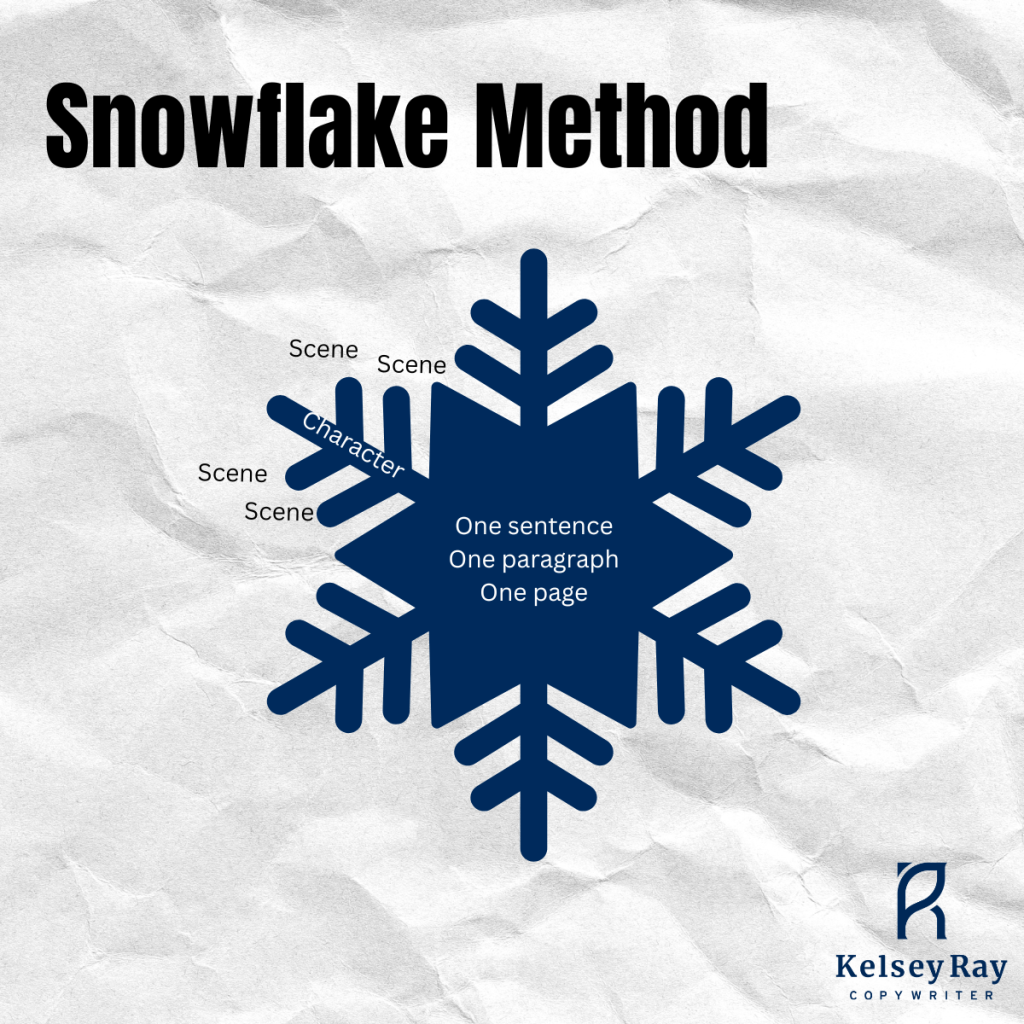
Write one-sentence to encapsulate the entire story. Then, use this sentence to write a paragraph that delves into the conflict, plot, and theme. Next, write a one-page summary for each major character. And finally, use all of these to map out the story scenes.
I normally find this method too much work for a single blog post or white paper. But it’s perfect for overarching content narratives, especially if you have multiple buyer personas.
7-Point Story Structure
Unlike many of the narrative forms that focus on character, the 7-point structure emphasizes action and pacing. I often see this story structure in short-form content, like ads or social media reels. The components almost mirrors Aristotle’s method:
- Hook/Status Quo: What is normal?
- Plot Turn 1: Something changes the normal flow—-usually a problem or an antagonist.
- Pinch 1: Things get worse—the character must face trials.
- Midpoint: The main character takes action.
- Pinch 2: Things get worse (again). It may or may not be related to the character’s previous action.
- Plot Turn 2: The “realization” of change.
- Resolution: The problem is solved and tension dissipates.
Mapping Narrative to Marketing Funnels
Not every narrative structure matches every content type, or even every funnel. Your reader is the protagonist, but their journey isn’t necessarily linear. It’s rarely brief, especially in the B2B world in which these stories supplement sales, not drive them.
Ultimately, I prefer to use the Fichtean Curve, the beat structure, or the snowflake method for organizing content topics, planning distribution, and finding interlinking opportunities. They are great for multi-persona brands that require hyper-personalized interactions. For example, a healthcare clinic that treats both ADHD and addiction have distinctly different expectations. Few topics overlap in content and perspective.
For short-form content like social media, reels, I layer the larger beats structure with Aristotle or the 7-Point Structure.
If there are multiple products or tiers, I may use the Heroine’ Journey to get cycle engaged users through new funnels. A farmer that is eligible and completes a seed treatment successfully may be more open to new technology or techniques. A buyer looking at intimate apparel and loved the confidence boost can easily be guided through wardrobe upgrades and accessories to expand the experience.
Small businesses can use these narrative scaffolds, too, to simplify their strategy regardless of capacity. Maybe they can do it all, but most likely they have to pick and choose which content types to produce. These storytelling staples can be applied to any workload.
In other words, it’s rather easy to leverage any of these narrative structures to upgrade not only individual pieces but your overall strategy. The question is: What’s stopping you?
You may also want to check out…
- Storytelling that doesn’t scream greenwashing
- How to market sustainable products
- When your payment brand content doesn’t stand out
Disclaimer: None of the brands mentioned in this article are my clients. I just really enjoy their work and wanted to brainstorm with their brand.