
Artificial intelligence (AI)-driven content writing solutions promote efficiency, agility, accuracy, and affordability as proof that this technology will streamline marketing workflows, increase ROI transparency, and keep management happy. Semrush’s 2024 AI Content Marketing report found that 71% of marketers who use AI believe their efforts to be more effective.
But the intersection of technology and content marketing generates more questions than answers about the moral implications of AI content and its long-term viability as a marketing strategy.
Ethical considerations regarding content often revolve around propaganda, whether it’s related to political or market manipulation. While AI technology offers some respite from the challenges of overwork and higher pressures to perform, it’s important to ensure the tools we integrate into our processes are viable in the long term. Unethical approaches to AI are not.
Today, we see numerous conflicts around AI adoption across industries. Some examples include ambiguities around:
- Content ownership and copyright law
- Labor exploitation
- Poor or biased datasets
- ROI measurements
- AI accuracy and performance
These considerations are broad, even when restricted to writing-specific tasks. AI and similar technologies can be used not just for writing but also for SEO keyword research, backlink recommendations, grammar corrections, content repurposing, and similar functions.
In this article, I’ll tackle some of the hard questions marketers and writers have about using AI ethically and cover topics like:
- Primary ethical concerns around AI
- AI limitations weighed against risks
- Ways to navigate the current content landscape
4 Moral Implications of AI Applications Today
Amazon’s recent no-checkout debacle, in which the business touted its human-powered Just Walk Out system as an AI solution, has highlighted one of several ethical considerations that individuals and companies must grapple with. Below, I’ve listed 4 clear immediate dilemmas related to AI technology and content marketing.
1. Surface-level Sustainability
One of the significant draws of the last decade’s digital transformation was sustainability. Shifting to a paperless environment while improving accuracy and efficiency enabled companies to integrate popular values—such as sustainability—into the workplace.
However, one of the costs of AI technology is a commitment to sustainability. At least, that’s the case right now.
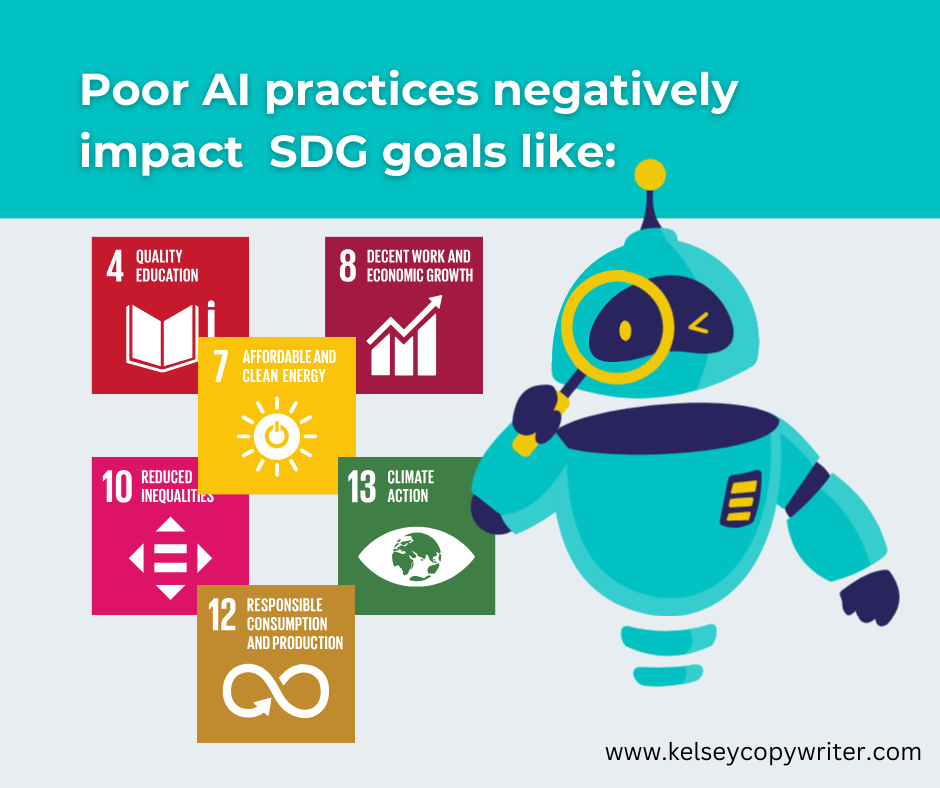
On the energy front, AI, particularly machine learning, is hungry. As the popularity of AI solutions grows, they require bigger models and datasets to maintain relevance. AMD CTO Mark Papermaster warned about AI’s exponential power consumption at a recent conference, stating that we are reaching an era of “anti-efficiency.” The energy costs of training the algorithm on the datasets, cooling the systems, and integrating new data all require significant resources.
Sustainability, of course, isn’t just carbon-based. Human exploitation factors in, too. Human content moderators, often used to train or correct AI algorithms, have been underpaid and exposed to violent or toxic content.
These workers may be so pressed for time and may be working under such miserable conditions that their feedback negatively affects the datasets used—resulting in AI inaccuracies and misrepresentations. In content writing, these inaccuracies could be as “small” as an incorrect comma placement or as large as promoting racist or sexist ideologies.
2. Unwilling Sources
Another critical ethical issue is where these solutions are getting their data. This problem causes several challenges for marketers, whether your audience is B2C or B2B. But it affects everyone on multiple levels.
For example, let’s take the Sudowrite fiasco. In late 2022 and early 2023, a generative AI app for fiction writers rightfully angered internet creatives when it was revealed that the app scrapped content by writers on Archive of Our Own, a fiction and fanfiction website, without the authors’ permission. Embarrassingly for Sudowrite, this was discussed when a user discovered erotica-based references in the program’s generated content.
This instance could at least be a little funny—but it presents many ethical issues:
- Why were users not given an opt-out option for their works to be used?
- Fiction and fanfiction can take dozens of hours to produce—should the authors not be compensated?
- If algorithms cannot understand differing contexts for words like “alpha,” how can we rely on its accuracy with more complex topics and hard data?
- How is content moderated and approved for training? What are the criteria?
And it’s not like the data AI companies are using are necessarily harmless. OpenAI, the founders of ChatGPT, also used personal information in their datasets. Not only may personal, sensitive data be at risk, but it can also be inaccurate. The last thing you want, as a writer, is to include research about a company, product, or person and, because of a lapse in fact-checking, be completely wrong about that topic.
This is also a potential security risk for marketers working with AI systems. If you upload sensitive data into an AI solution to summarize or compile data, you no longer have control over who has access to it. According to Menlo Security’s recent generative AI impact report, 55% of data loss events involved users inputting sensitive data into generative AI sites.
3. No, You (and Your Clients) Don’t Own It + More Legal Woes
The two risks above can lead to legal liabilities. It is copyright infringement to gain consent to use the material for AI training, and potential labor exploitation can also turn into lengthy court cases.
But you also have the problem of ownership—can you own what you create with AI? So far, the answer is no. The argument is that only human-created works can be copyrighted. And so, accusations of plagiarizing the source material aside, AI content is fair use.
Legal copyright is incredibly important to both B2C and B2B clients. Whether you are a marketer for a firm or freelancing for several companies—that client will almost always have a contract stating that they own the material you produce.
Using unmodified AI can put you and your client into a few legal issues:
- The content generated may use copyrighted material or material collected without consent.
- Your client may accuse you of plagiarism if the generated content is too close to the original.
- Your client may be sued for plagiarism.
- Your client may be penalized by another distribution system for using AI content.
- Inaccuracies in content due to AI could result in lawsuits related to misrepresentation or non-compliance, depending on the requirements of the client’s industry, content topic, and products.
Even if you modify the content before publishing it, that may not be enough. The legalities are still fairly broad.
4. Content Cannibalization is Killing Quality
Content writers and marketers aren’t fiduciaries—but we shouldn’t be publishing poor quality or unhelpful content, either. The remarkable phenomenon of AI cannibalism is making it harder for creators to use AI in the first place.
AI cannibalization occurs when AI solutions use AI-generated content in their training sets. In this case, AI regurgitates an AI article that is a crudely stitched-together version of multiple original articles. This occurrence can create significant platform issues, result in biased results, or strip context from generated content, making the end result vague and inaccurate.
As more AI articles filter through the search results, we’ll likely see a spiraling decrease in quality and accuracy. This will affect end-users, clients, and writers.
Follow-up: Does Using AI Merit the Risk?
More importantly, does generative content work well enough to merit taking the risks?
After all, many ethical considerations above are not in the writer’s or marketer’s control.
The practical use cases for AI technology in content marketing are limited. While the Semrush report mentioned earlier in this article suggested that marketing professionals believe they are more effective, that isn’t necessarily true.
The same report, for example, found that before using AI, 39% of respondents spent 5-10 hours a week on content. It dropped to a marginal 36% after using AI results. While the biggest benefits seemed to be saving time and money, almost half were worried that their AI content was not original enough.
Other studies have found similar results. A report from Marketing Insider Group found that human content drove more traffic and was less susceptible to declines after SEO updates than AI-generated content.
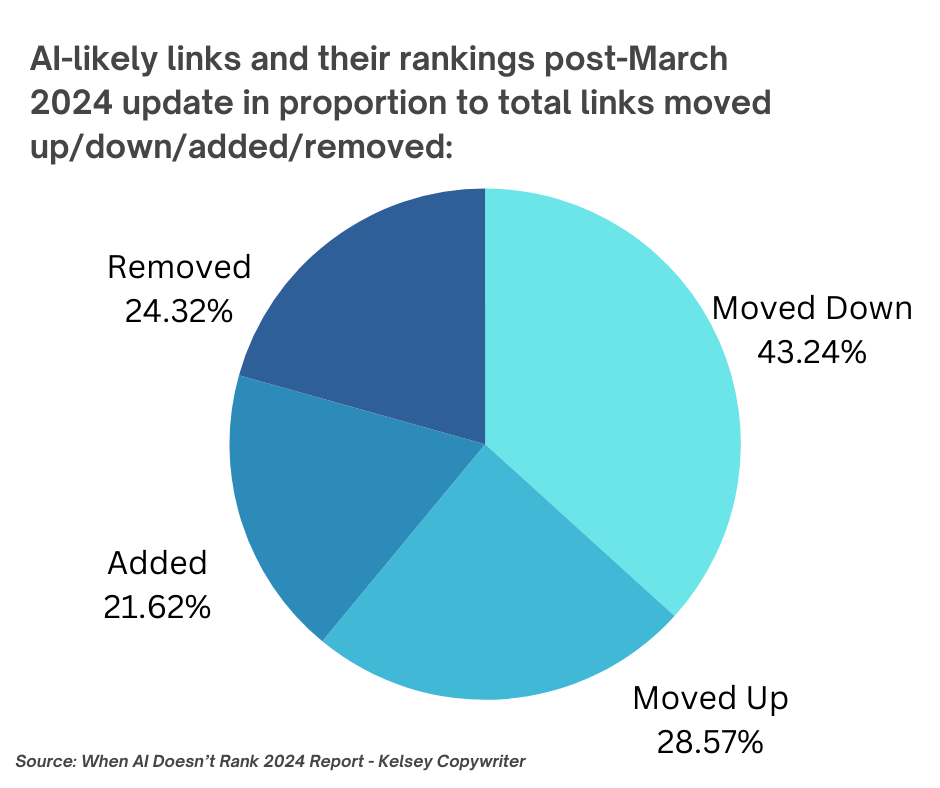
This coincides with my own study of AI content, in that the 43.24% of links in the top 10 search results for surveyed keywords moved down after the March 6th, 2024 Google update were more likely to be AI-written. Another 24.32% of likely AI-generated content links were kicked off the top 10 list.
Furthermore, on a personal level, I have found generative tools to be less effective than writing from scratch. After using several free and paid platforms, I found that drafting, editing, revising, and fact-checking articles written with AI increased my time spent on each project by 30-50%.
Just because AI is faster at spitting out words in coherent sentences does not mean it can execute the assignment.
De-risking Your AI Workflow
Given how little writers and content creators can do about how AI tools are created and trained, there are limits to how we can push back. But there are ways to leverage AI.
The simplest solutions are:
- Support companies that compensate or gain consent from dataset contributors
- Search for AI solutions that have sustainability procedures in place, if possible
- Use AI when you need to, don’t use it as a default tool
- Advocate for AI to reveal its dataset sources, at least for factual claims
- Don’t depend entirely on AI for any one task—ensure a human being reviews the research, draft, and revisions.
- Source your own data for articles and content—don’t depend on AI for statistics, math conclusions, or facts.
You may also wonder about AI content detectors, especially if you are supervising other writers or content creators. However, AI content detectors are hardly ideal.
AI content detectors use pattern recognition and mathematical probabilities to identify how likely an AI program wrote an article. There are a few different ways these platforms work, including turning words into data points and matching labeled patterns to submitted content. Most also define content against two attributes:
- Perplexity, or how unexpected the next part of a text is
- Burstiness, or how much sentence and word variation there is
Neither are particularly good indicators of human vs. AI speech. These two primary factors don’t necessarily consider, for example:
- Dialect variation
- Accuracy
- Spelling and grammar
- Tone
- Client instructions
- New slang, industry jargon
Ironically, one test found that rough drafts, which are usually lower quality, scored as more human than proofread drafts.
It appears that AI vs. human identifications currently hinges on the idea that humans will make more mistakes than humans—a crucial misunderstanding in the heat of the AI-content debate.
AI is a tool. Like any other tool, it can easily make mistakes if not applied correctly.
Unfortunately, with regulations around AI ethics and content creation still in their infancy, we’ll likely see more of its limitations and misuse as it becomes more popular.
But Doesn’t AI Outrank Human Content?
Spoiler alert: No, not necessarily.
I recently analyzed the top 10 results for around 300 finance industry keywords and reviewed 14 keywords in-depth to analyze the relationship between AI content and SEO.
You can read the full report for free. No email is required. 🙂